Revenue Sharing is Equilibrium: Why Stablecoins Will (and Should) Pass Through Yield
Abstract
Stablecoin issuers sit on a predictable carry stream from user float. That gravy train is ending, on Ethereum alone using our model nearly $5bn a year could, and should, be redistributed away from the issuer. With more than one credible issuer and one click on-chain outside options, competition on the rebate drives . Even a monopolist must share when the adoption floor is pinned by outside options: . The conclusion is blunt, revenue sharing is equilibrium, not a marketing giveaway as might be common in crypto circles.
Summary
If you can earn roughly four percent on-chain with a single click, then any stablecoin that offers a lower payout has to compensate in some other way, through trust, convenience, or regulatory cover. Without that, users will migrate.
Once two or more serious issuers exist, they are forced into a race to outbid one another on the rebate y, the share of reserve yield passed through to holders or the broader ecosystem. In the simplest economic model, that dynamic drives y toward 100%. Reality checks the spiral before it hits the limit, but only because users still place value on brand trust, user experience, and compliance.
Even a monopolist cannot avoid paying altogether. As soon as there are credible outside options, the monopolist must at least offer the minimum pass through that clears adoption. Formally:
,where is the utility of the best outside option, is the baseline utility of holding the stablecoin without any rebate, and is the reserve yield.
Attempts to cartelize and hold back yield are inherently fragile. The larger the number of issuers, the higher the discount factor needed to sustain collusion, and the harder it becomes to enforce cooperation.
We have seen this exact process play out before in MEV markets: rents that initially accrued to insiders were eventually forced outward toward users. Stablecoin carry is simply the same game, this time dressed in more respectable clothes. (For context see MEV 2.0: The Rise of MPSVs)
The One-Minute Intuition
There are only two levers that matter for a normal user: (1) "What do I earn here?" or perhaps more generally "What does the ecosystem earn here?" and (2) " How painful is it to move?" If a composable, on-chain outside option earns and the coin's baseline utility is (payments, integrations, merchant acceptance), the gap has to be closed with a rebate . If two issuers can both flip that switch, they will, because failing to do so loses the market. This is not out of generosity; it's the economic equilibrium.
2. Setup
Consider symmetric stablecoin issuers . Each chooses a rebate on a per-dollar annual reserve return . (As a concrete anchor, use the 7-day SEC yield on BlackRock's USDXX (the Circle Reserve Fund), net expense ratio . As of late Sep 2025 the posted 7-day SEC yield is . See 6. Calibration)
A representative mass of users allocates to the issuer(s) offering the highest , breaking ties uniformly. Issuer 's per-dollar stage payoff is
Interpretation: rebate is the price instrument; higher attracts users, but leaves less carry to the issuer.
3. One-Shot Competition: Bertrand on Rebates
Proposition 1 (Static Nash):
With , is a (symmetric) Nash equilibrium of the one--shot game.
Sketch. If all set , each issuer earns . Any unilateral deviation to loses all users to opponents at , yielding , not strictly better. Deviating to is infeasible. Hence is a Nash equilibrium. As in standard Bertrand, any putative equilibrium with is unstable: someone can raise by and capture the entire market.
In practice, issuers may differentiate (trust, liquidity, UX, regulation), which effectively raises or lowers perceived . This shifts but does not overturn the logic.
4. Adoption Constraint: A Monopolist Still Shares
Let denote the baseline utility from holding an issuer's stablecoin even at zero rebate (e.g., payments convenience, integrations, merchant acceptance). Let be the user's annualised on-chain outside option (e.g., tokenised T-bills / money-market exposure). A monopolist issuer chooses to maximise. Let be the user's annualised on-chain outside option (e.g., tokenised T-bills / money-market exposure). A monopolist issuer chooses to maximise
Proposition 2 (Adoption Threshold). The issuer's optimal rebate is
Sketch. Objective is decreasing in on the feasible set; the smallest that satisfies adoption binds: when , clipped to . If , the constraint is slack and .
This shows that even a monopolist must share yield whenever users have credible outside options; higher or lower pushes up.
Proposition 3 (Ecosystem Pass-Through and user incidence): If the rebate is routed to an ecosystem sink (burn/buyback/fund) rather than paid to holders, let be the share of each value unit of ecosystem rebate that accrues (in utility terms) to the marginal stablecoin user. The adoption threshold becomes
Sketch. Relative to , the marginal user derives rather than . Substitute into the adoption constraint and clip to .
If (e.g., burns/buybacks mainly benefit chain‑token holders), more rebate is required to clear user adoption. If adoption is brokered by a platform or chain that captures the rebate, then setting for the platform rebates the platform over the direct user, like USDM and USDH. Even without direct incentives users are likely to align with tokens seen as improving the broader ecosystem so use migration likely remains similar to the non-platform case. When a chain/exchange selects the default stable and captures the rebate, the Proposition 2 logic applies with the platform as the user. With issuers, equilibrium bids to the platform, absent differentiation that raises the platform’s or lowers its .
5. Cartels Fail Unless the Market Is Tiny and Patient
Consider the infinitely repeated game with common discount factor and a symmetric cartel at sustained by grim trigger: if anyone deviates, all revert to forever. Per period:
(a deviator can outbid cartel members by to capture the entire market for one round; afterwards all revert to ). Collusion is incentive compatible if
Proposition 4 (Cartel sustainability). A symmetric cartel at any is sustainable under grim trigger only if . As grows, .
That is to say that with you need ; with , . "Holding back yield" is fragile in any moderately competitive market.

Figure 1: Cartel fragility. Minimum discount factor needed to sustain a cartel at under grim trigger: . With , .
6. Calibration: Dollars at Stake Today
Take (USDXX 7-day SEC yield, net). (BlackRock USDXX fund page and factsheet: https://www.blackrock.com/cash/en-us/products/329365/circle-reserve-fund and https://www.blackrock.com/cash/literature/fact-sheet/circle-reserve-fund-institutional-fact-sheet.pdf.)
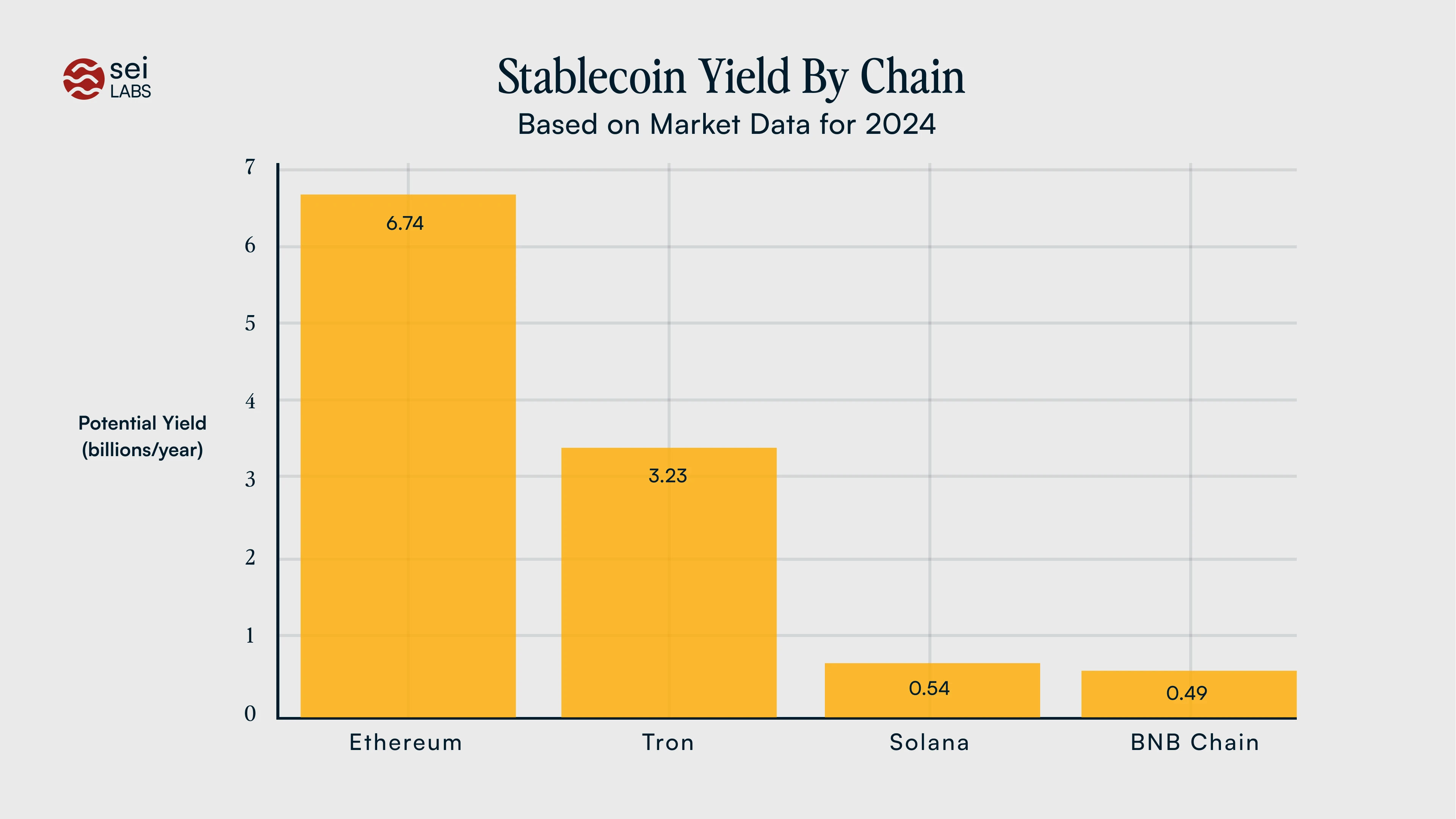
For scale, per–chain stablecoin float (DefiLlama) is roughly:
Chain | Supply | Annual pool | Users @ 70% | Issuers @ 30% |
|---|---|---|---|---|
Ethereum | B | B | B | B |
Tron | B | B | B | B |
Solana | B | B | B | B |
BNB Chain | B | B | B | B |

Figure 2: Scale today. Annual reserve-yield pool by chain using and DefiLlama supplies from late 2025.
(That is B/year across these four chains.) (DefiLlama stablecoin supply by chain: https://defillama.com/stablecoins/chains) Token level: USDC B in circulation; USDT liabilities B as of the Q2 2025 attestation, implying annual interest pools near B and B respectively at . (USDC/Circle pages: https://www.circle.com/usdc and transparency hub https://www.circle.com/transparency. Tether Q2 2025 attestation and release. A macro cross-check for cash/T-bill yields: FRED 3M T-bill series DGS3MO/TB3MS.)
A single picture that explains the policy. Let as a disciplined estimate of a chain's "use value." Then the minimum pass through to clear adoption is (clipped to ). When on-chain outside options are , . That is why, in practice, most of the carry must be returned to users. (Outside options include on-chain money market exposure (e.g., USDXX) and tokenised T-bill products; see sources in the previous footnote.)

Figure 3: Adoption floor. Minimum pass-through as outside options improve, with and . When , .}
Who gets what at 70%. If an issuer targets a simple pass through, users receive $ 4.72 B /year on Ethereum and $2.26B on Tron; issuers still retain material revenue.

Figure 4: Who gets what at . Users vs issuer split of per chain. Users take 70% of the pool; issuers retain 30%.
7. Industry Arc: Why This Is Where We End Up
The trajectory is familiar from the MEV wars. MEV started as validator/builder rent. Competition and credible routing then forced more surplus back to orderflow originators. The next step, “MPSVs” (MEV Profit Sharing Validators), made users explicit beneficiaries of MEV. (“MEV 2.0: The Rise of MPSVs”)
Stablecoin carry is structurally the same: a predictable yield stream created by privileged access to user float. Once outside options are on-chain, composable, and one click away, the adoption constraint hits:
Then competition on does the rest. Attempts to cartelise at fail unless is tiny and is very high. The industry has already moved in this direction de facto: revenue splits with distribution platforms, exchange partners, and wrappers; the natural endpoint is explicit pass through to holders.

Figure 5: Issuer margin compresses with pass-through. Per of float, issuer gross is . At and , gross p.a.
Assumptions and Caveats
This analysis is based purely on theoretical assumptions. There are real world regulations addressing stablecoins that affect both implementation and adoption that are not considered in this work.
The analysis rests on several simplifying assumptions. First, users are treated as having homogeneous preferences and identical sensitivity to rebates, so differences in adoption do not arise from heterogeneous demand. Information is assumed to be perfect, with all participants able to observe the posted rebate without frictions or delays. Issuers are taken to hold reserves of identical composition and risk, eliminating the possibility of differentiation through portfolio choice.
Switching between issuers is assumed costless, so users can move freely across stablecoins in response to even small differences in rebates. Where trust, user experience, or regulatory compliance matter, they are modelled as either raising the baseline utility of holding a given stablecoin, or lowering the perceived outside option . This reduces the required pass through , but does not alter the comparative statics of competition.
Finally, the calibration is intended as order-of-magnitude illustration rather than forward guidance. Both interest rates and stablecoin supplies fluctuate over time, so the numbers should be read as indicative rather than predictive.
Join the Sei Research Initiative
We invite developers, researchers, and community members to join us in this mission. This is an open invitation for open source collaboration to build a more scalable blockchain infrastructure. Check out Sei Protocol’s documentation, and explore Sei Foundation grant opportunities (Sei Creator Fund, Japan Ecosystem Fund). Get in touch - collaborate[at]seiresearch[dot]io
References
MEV 2.0: The Rise of MPSVs — https://recvc.com/insights/mev-2-0-the-rise-of-mpsvs
BlackRock Circle Reserve Fund (USDXX) — https://www.blackrock.com/cash/en-us/products/329365/circle-reserve-fund
Circle Reserve Fund Factsheet — https://www.blackrock.com/cash/literature/fact-sheet/circle-reserve-fund-institutional-fact-sheet.pdf
FRED 3-Month Treasury Bill Yield — https://fred.stlouisfed.org/series/DGS3MO
DefiLlama Stablecoins by Chain — https://defillama.com/stablecoins/chains
Circle USDC & Transparency — https://www.circle.com/transparency
Tether Q2 2025 Attestation — https://tether.io/news/tether-issues-20b-in-usdt-ytd-becomes-one-of-largest-u-s-debt-holders-with-127b-in-treasuries-net-profit-4-9b-in-q2-2025-attestation-report